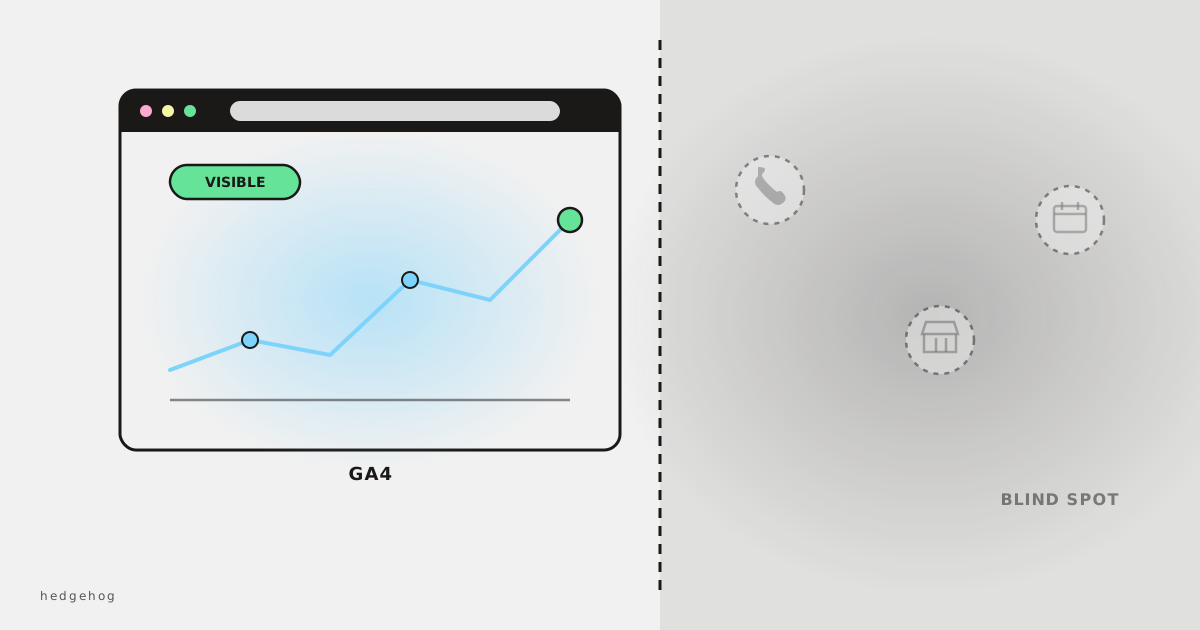
GA4 is a website analytics tool. It counts sessions, pageviews and the events you've told it to watch for. That's useful, but it is not a substitute for knowing what happened in your booking system, your point of sale, or your bank account. It cannot verify that a lead who ticked a website conversion event ever became a paying customer.
That gap matters because so much advice treats GA4 as if it closes it. "Just get GA4 set up and you can track everything" is one of the most common lines business owners hear from agencies and from generic online guides, and it's doing real damage. It sends people into decisions about ad spend, campaigns and channels using half the picture, especially in industries where the actual sale happens somewhere GA4 has zero visibility: in-store, over the phone, or inside a separate booking app.
Key Summary
- GA4 only sees what happens on your website: sessions, pageviews and the on-site events you've configured.
- A GA4 "conversion" (a form fill, a click-to-call, a booking button click) is an event firing, not proof someone paid you.
- Any business where the sale finishes off-website (in-store, on the phone, in a separate booking app) has a blind spot GA4 physically cannot see into.
- "Just track it in GA4" as blanket advice sets business owners up to judge marketing on incomplete data.
- A proper measurement stack cross-checks GA4 against what actually happened in the business: bookings taken, sales closed, revenue banked.
- Treat GA4 as one input into a decision, never as the verdict.
What GA4 Actually Measures (And What It Doesn't)
GA4 is built to measure behaviour on your website and app. Sessions, pageviews, scroll depth, button clicks, form submissions, time on page. It's good at this, and for understanding how people move through your site before they leave it, there's no real substitute.
What it can't do is follow that person anywhere else. Once someone leaves your website, whether they call your shop, walk into your store, or open a separate booking app to actually make the appointment, GA4's visibility ends. A GA4 "conversion" is a proxy: it tells you an event fired, not that a sale happened. A form submission event means someone submitted a form. It doesn't mean they became a customer, and it definitely doesn't mean they paid you money.
This is where "GA4 setup" as a service quietly oversells itself. Getting GA4 configured correctly, with clean events and sensible conversion definitions, is real, valuable work. But configuring it well doesn't extend what it can see. It just makes the on-site picture sharper. The limitation isn't a setup mistake you can fix; it's built into what kind of tool GA4 is.
Why "Track It In GA4" Became Everyone's Default Advice
GA4 is free, it's the industry standard, and it's straightforward to get a dashboard full of numbers out of it. That combination makes it an easy sell. An agency can point at a report full of sessions, conversions and channel breakdowns and call the job done, and most business owners, reasonably, assume that if the platform reports a conversion, something got converted.
Generic online advice compounds this. Most "how to track your marketing" content stops at "install GA4, set up your conversions, you're done." It rarely mentions that a GA4 conversion event is not the same thing as a customer, or that anything happening off-website needs its own tracking layer entirely. The advice isn't wrong exactly, it's just incomplete, and incomplete measurement advice is what leads business owners to make real decisions (cutting a campaign, doubling down on a channel) off a number that was never the full story.
The Businesses Getting Burned Most
The damage from this scales with how much of the sale happens away from the website. A pure ecommerce store checking out entirely on-site is in reasonable shape, GA4's ecommerce tracking gets you close to revenue. Everyone else is carrying a bigger gap than they think.
Take a mechanical workshop running Meta ads. Someone sees the ad, taps through to the site, and calls the shop directly from their phone rather than filling in a form. Unless call tracking is wired in specifically, that phone call, and the booking that followed it, never shows up in GA4 at all. The campaign looks like it underperformed. It didn't, GA4 just wasn't watching that channel.
Run it the other way and it's worse: a lead fills in a website form (a clean GA4 conversion), gets a call back, and never books, or books and no-shows, or books, shows up, and doesn't buy. GA4 recorded a conversion. The business made zero dollars. Fitness studios booking through a separate membership platform, trades quoting jobs over the phone, clinics booking through practice-management software, and any retailer with a real shopfront are all sitting on the same structural gap.
Building a Measurement Stack GA4 Can't Fake On Its Own
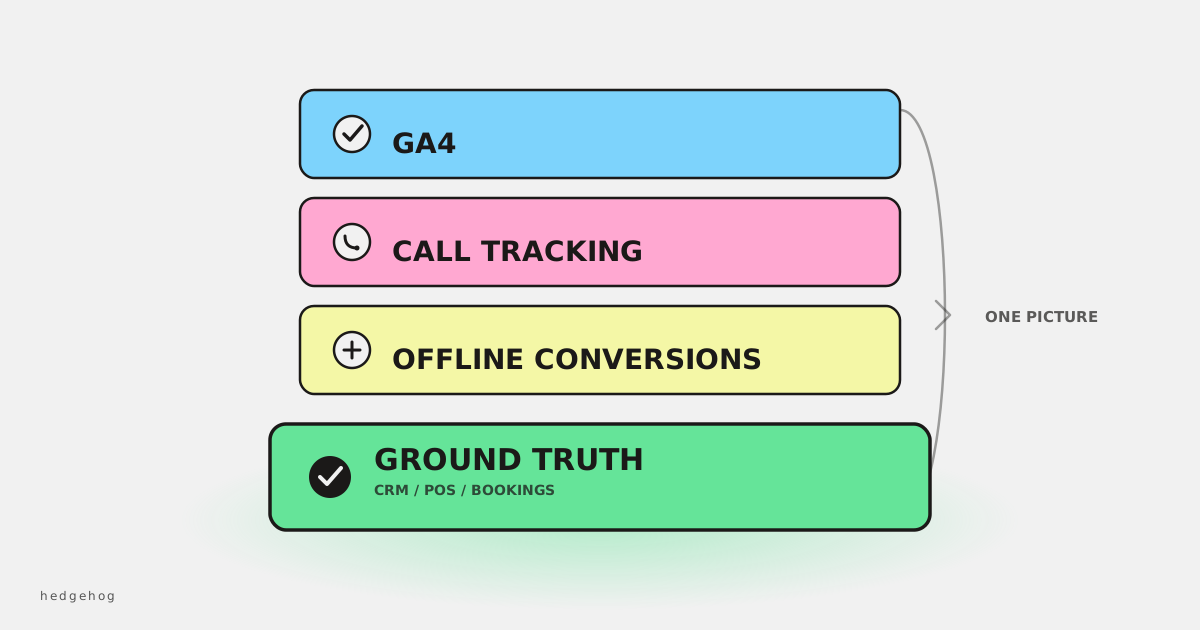
The fix isn't dropping GA4, it's refusing to let it stand alone. A real measurement stack layers GA4 with the systems that actually record whether money changed hands.
Call tracking closes the phone-call gap, attributing calls back to the campaign, keyword or ad that generated them, so they stop disappearing into "direct" traffic or vanishing entirely. Offline conversion imports feed real outcomes (a booking that was kept, a sale that was closed) back into GA4 and the ad platforms, so the algorithm and your reporting are both working from what actually happened rather than what merely got clicked. Your booking system, CRM or point-of-sale exports are the ground truth: the record of who actually paid you, matched back against the marketing data that claims credit for it.
None of this needs to be elaborate. Even a monthly manual reconciliation, pulling GA4 conversions next to actual bookings or sales for the same period, tells you how far apart the two numbers are and whether that gap is growing or shrinking.
How to Check Every Marketing Conclusion Against What Actually Happened
Before any marketing decision gets made off a GA4 report, run it past one question: does this match what the booking calendar, the till, or the sales team actually saw? If GA4 says leads jumped 30% this month, check whether bookings, sales or revenue moved anywhere near that. If they didn't, that gap is the finding, not the campaign's success.
Make this a habit rather than an audit you do once a year. A short monthly reconciliation between GA4 and the business's actual numbers catches attribution problems early, before a whole quarter of budget gets allocated on the strength of a number that was never verified against reality.
Frequently Asked Questions
Isn't GA4 enough for a small business with a simple website?
If every sale completes on the website, with proper GA4 ecommerce tracking in place, GA4 gets you much closer to the real picture. Even then, reconcile it against your actual order and payment data occasionally. The moment any part of the sale happens off-site (a phone call, an in-person visit, a separate booking system) GA4 alone stops being enough.
What's the fastest way to find out how big my gap is?
Pull last month's GA4 conversions and compare them, side by side, to your actual paying customers for the same period. The size of the difference tells you exactly how much weight you can safely put on GA4 numbers alone.
Should I stop using GA4 altogether?
No. GA4 is useful for understanding on-site behaviour, traffic sources and where people drop off. The problem was never GA4 itself, it's letting it be the only number in the room when a decision gets made.
My agency says GA4 is all we need for tracking. Is that normal advice?
It's common advice, and it's usually incomplete for any business where part of the sale happens off the website. Ask how the reported conversions get checked against actual revenue. If there's no clear answer, that's the gap this article is about.
What should I actually be measuring alongside GA4?
Not instead of it, alongside it: bookings taken, sales closed, revenue banked. GA4 tells you what happened on your website. Your business's own systems tell you what happened to your bottom line, and that's the number that actually matters.
Wrapping Up
GA4 is a useful website analytics tool, and a limited one. It was never built to verify a sale, and treating it as if it can is what turns "we're tracking everything now" into a business owner making decisions off half the picture. The fix is simple to say and worth the discipline: keep GA4, add the layers that record what actually happened (call tracking, offline conversion data, your own booking or sales system), and check every marketing conclusion against real bookings, sales and revenue before you act on it.
If you're not sure how big the gap is between what GA4 is telling you and what's actually landing in your business, that's worth finding out before your next budget decision, not after it.