Meta rebuilt the front end of its ad system and most advertisers are still running the old playbook against it. The system is called Andromeda, and it decides which ads are even considered before ranking and the auction happen. The practical consequence is a single sentence: the creative is the targeting.
That inverts how you build a campaign. The old instinct was to split audiences into separate ad sets and average one message inside each. Under this engine that’s worse than useless. It starves every ad set of conversion signal and hides the range the algorithm needs to route with. The right shape is one consolidated campaign carrying creative that spans every awareness phase, letting the algorithm match each ad to the person it lands with. Here’s how to build that.
#Key summary
- Andromeda is Meta’s ad retrieval engine. It narrows tens of millions of candidate ads down to a few thousand, which then go to ranking and the auction.
- Meta reports a 6% improvement in retrieval recall and an 8% improvement in ad quality on selected segments since deploying it.
- Segmentation moves out of the targeting layer and into the creative layer. You write an ad for a segment, you don’t build an ad set for it.
- Build the slate across five awareness phases: Unaware, Problem Aware, Solution Aware, Product Aware, Most Aware.
- Consolidate. Fewer ad sets is the only way most accounts reach the conversion volume the learning phase needs.
- Protect what works with a separate testers campaign. Winners get promoted, losers die somewhere that isn’t paying the bills.
#What Andromeda actually is
Meta’s ad delivery is a pipeline: retrieve, rank, auction. Andromeda is the retrieval stage. Every time someone opens Instagram there are tens of millions of ads that could theoretically be shown to them, and something has to cut that to a few thousand worth ranking properly.
Meta published Andromeda on 2 December 2024, and it was already running across Facebook and Instagram at that point. It uses a custom deep neural network with hierarchical indexing, running on NVIDIA Grace Hopper Superchips and Meta’s own MTIA silicon. Meta’s figures put the model capacity increase at 10,000x, with a 6% improvement in recall, an 8% improvement in ad quality on selected segments, and over 3x the end-to-end inference throughput.
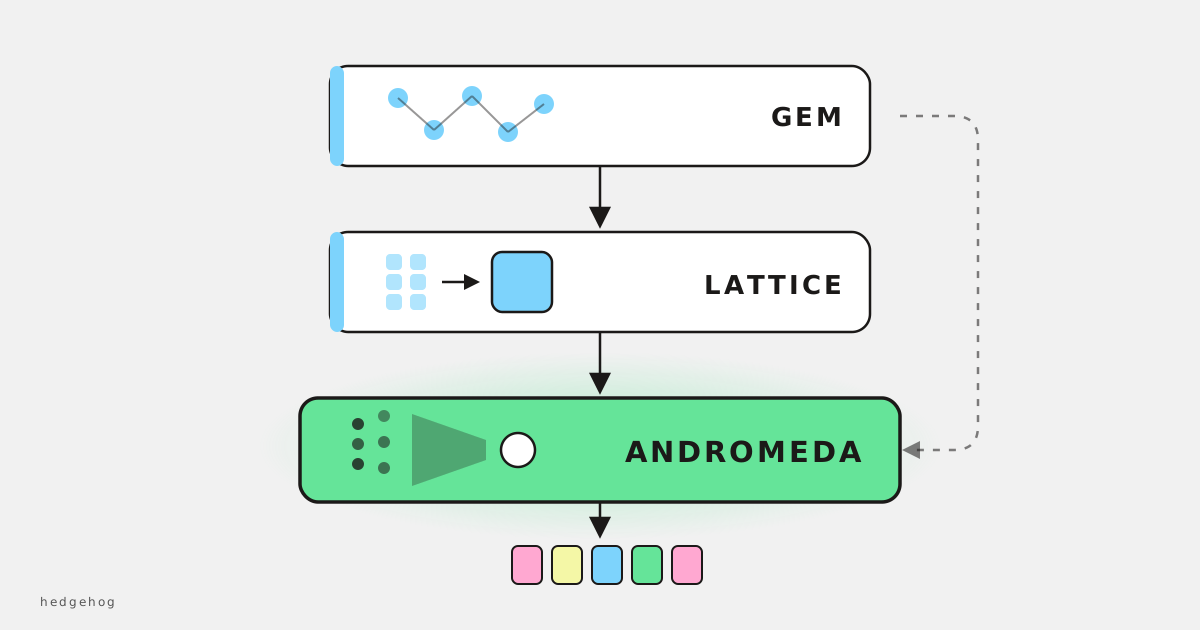
Andromeda isn’t the only thing that changed either. Meta has published GEM, a foundation model for ads recommendation that passes what it learns down to the models serving your ads, and Lattice, which merges what used to be dozens of separate ranking models into unified networks. Meta has never published these as one neatly labelled stack, so the tidy diagram doing the rounds on agency blogs is interpretation rather than documentation. What is documented is the direction of travel: fewer, bigger, more general models replacing lots of small specialised ones.
That’s the part that should change your decisions. A general system is much harder to game with structural tricks, and much more responsive to what you actually put in front of people.
#Segmentation moves into the creative layer
Here’s the shift stated plainly. You still decide who your ad is for. You just express that decision in the ad instead of in the audience settings.
Write an ad for the 45 year old tradie worried about cash flow, and you have described that person to the machine far more precisely than any interest picker ever let you. Then write a different ad for the person who already knows who you are and is stuck on price. Two ads, two segments, one ad set.
What stays at the targeting layer is only what the algorithm should not be allowed to overrule: exclusions, geography, and any legally required floors. Cut existing customers if you’re prospecting, cut the postcodes you don’t service. Everything else is now a creative decision.
That includes retargeting, and this is the part people resist hardest. You don’t need a separate retargeting campaign any more. Retargeting is what your Most Aware creative does, sitting inside the same consolidated campaign as everything else. Pulling it out into its own campaign fragments the signal all over again for no benefit.
Two consequences follow, and they’re the whole game:
Range is the strategy. A slate of near-identical ads gives the algorithm nothing to route with. Five colour variants of the same static are not five ads, they’re one ad in five outfits. Range across phases, formats and registers is what makes the structure work at all.
Consolidation fixes the learning phase. Fewer ad sets is the only way most accounts get near the conversion volume the learning phase needs. Never build a structure that re-fragments it.
#The five awareness phases
This is how you get range on purpose rather than by accident. Build the slate by awareness phase, not by format.
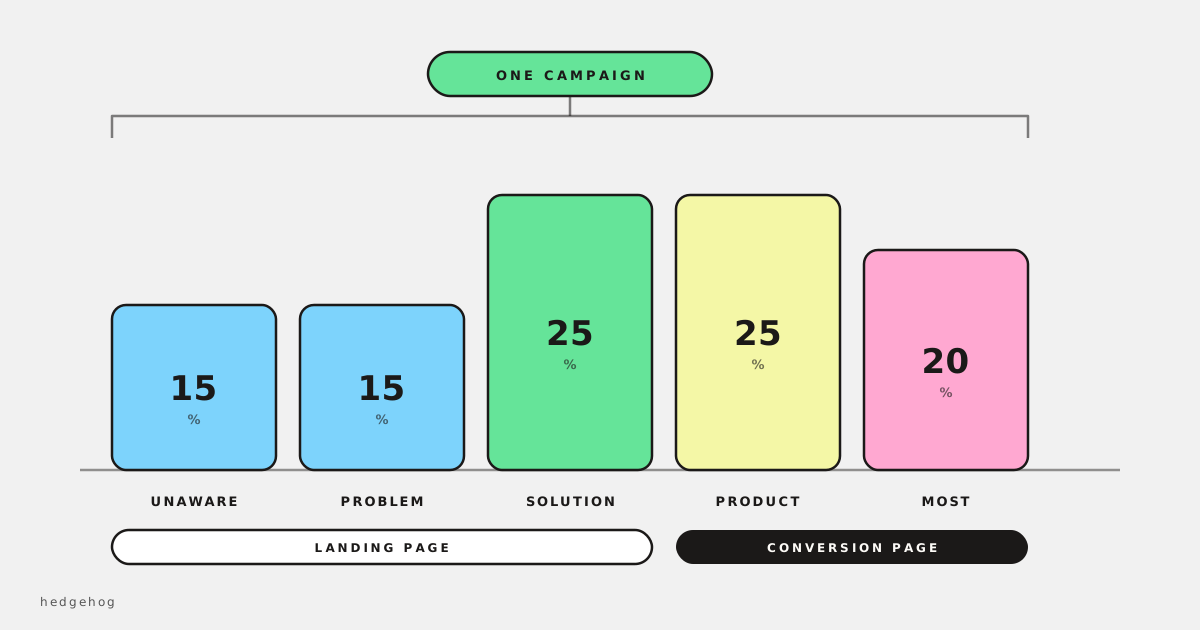
| Phase | Who they are | What the ad has to do | Destination | Share |
|---|---|---|---|---|
| Unaware | Don’t know they have a problem. The status quo feels normal. | Make them feel it. A pattern interrupt that lands as “wait, that’s me”. Names no category, sells nothing. | Landing page | 15% |
| Problem Aware | Feel the pain and can name it, but haven’t gone looking. | Name the problem precisely, in their words, and show a fix exists. Introduces the category, not the brand. | Landing page | 15% |
| Solution Aware | Know the category, actively evaluating options including competitors. | Make the argument. Why this business over the alternatives, why now. | Landing page | 25% |
| Product Aware | Know you. Haven’t bought. Sceptical, burned before, or waiting on someone else. | Kill the one specific objection, with proof. | Conversion page | 25% |
| Most Aware | The warm pool: engagers, site visitors, checkout abandoners. | Remove friction and give an honest reason to act now. | Conversion page | 20% |
Unaware and Problem Aware are not the same thing, and blurring them is the most common way a slate ends up with no real top of funnel. Unaware creative never mentions the problem as a problem. It shows the situation and lets recognition do the work: “the third time this week you re-did the roster at 9pm”. Problem Aware says it out loud and points at a fix: “rostering is eating your evenings. It doesn’t have to.” If an ad could swap between the two without rewriting it, it’s Problem Aware, and you’re one concept short up top.
Flex the shares to your situation. New business nobody has heard of, weight the top three to 60% or more. Category nobody knows exists, Unaware and Problem Aware carry up to 40% combined. Retargeting already saturated with frequency climbing and CPA flat, don’t add lower-funnel ads, because more there buys frequency rather than buyers. And on day one there is no warm pool, so Most Aware starts switched off.
On volume: aim for 15 to 30 ads weighted to those shares. At fifteen that’s roughly 2 Unaware, 3 Problem, 5 Solution, 4 Product, 1 Most Aware. Add new ads a few at a time rather than swapping the lot, because replacing everything at once resets what little the account has learnt.
#Protect the winners, kill the losers somewhere cheap
Consolidation raises an obvious problem. If everything is in one campaign, how do you test without wrecking what’s already working?
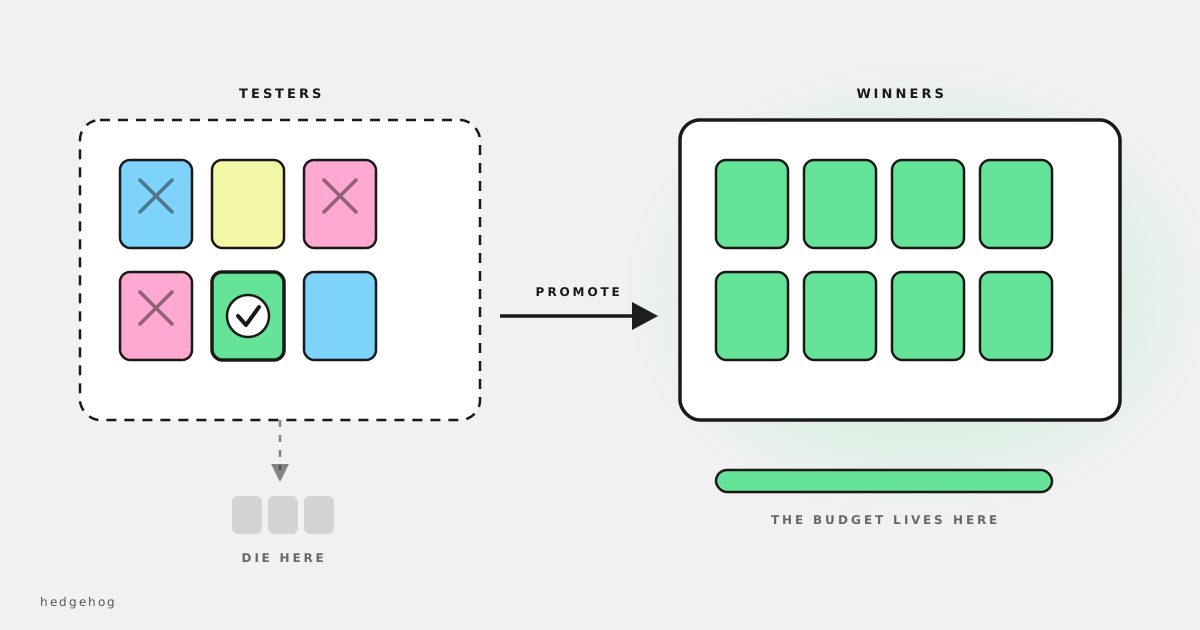
Run a separate testers campaign carrying only new creative, and leave the main campaign alone. Winners get promoted into the main campaign once they’ve proven themselves. Losers die in the tester rather than in the campaign paying the bills. This protects hard-won learning, which matters more at low conversion volumes than almost anywhere else.
If budget is tight, a small Traffic campaign beside the conversion campaign does a similar job for a fraction of the cost. Landing page views cost cents rather than hundreds of dollars, so a tiny traffic budget clears the learning threshold when the conversion campaign never will. It buys a fast read on which ads work, pixel activity that makes the main campaign smarter, and the warm pool retargeting needs before it can exist. Keep it around 5% of spend. It’s an instrument panel, not an engine.
#Where each ad points
Destination is a function of awareness phase, not audience segment.
Someone Most Aware has already been sold and just wants to buy. Every extra click is friction, so send them straight to the booking, checkout or enquiry step. Someone in the top three phases has been sold on nothing yet, and a checkout page can’t do that work. Send them to the landing page and let it carry the argument.
In practice that’s usually one page, two entry points, not two pages. Build one page per category and deep-link the warm traffic straight to the anchor where the form or checkout sits. Upper-funnel ads land at the top and read the whole argument. Product Aware and Most Aware ads skip to the business end of the same page.
The rule underneath it is one page per category. Not a page per campaign, not a page per awareness phase, not a separate landing page and conversion page. Every ad for a category points at the same page, so that page gets all the traffic and its conversion rate actually means something. Split the traffic across near-identical pages and you won’t be able to read any of them.
#Fix your signals before you blame the algorithm
If Meta is going to predict who converts, it needs to know who converted. This is where a surprising number of accounts quietly lose.
Run the pixel and the Conversions API together with deduplication in place, so browser blocking and privacy settings don’t leave holes in your data. Check your Event Match Quality score in Events Manager and treat anything low as a job to fix, not a number to ignore.
Then pick one priority conversion event and commit to it. Optimising for three things at once means optimising for none of them clearly. And if you’re generating leads, feed quality back in where you can. A system optimising for “form submitted” will happily bring you a mountain of rubbish forms.
#What to do in the next 30 days
- Map your existing ads to the five phases. Most accounts discover they’re running Solution Aware and Product Aware only, with nothing at the top.
- Write the missing phases. Unaware first, because it’s the one nobody has.
- Collapse your ad sets. Move segmentation into the creative and leave only exclusions and geography at the targeting layer.
- Set up a testers campaign so new creative stops interfering with proven ads.
- Fold any standalone retargeting campaign back in as Most Aware creative.
- Check every ad points at the right destination for its phase, and that each category has one page rather than four.
- Confirm the Conversions API is live and deduplicating, and look at your Event Match Quality.
- Give changes 7 to 14 days before you judge them. Pulling the lever every second day is the fastest way to learn nothing.
#Frequently asked questions
#How does the Meta ads algorithm work now?
It runs in stages. Andromeda retrieves a shortlist of a few thousand relevant ads from tens of millions of candidates, ranking models score them, then the auction picks a winner. Because your creative is what the system routes on, it now carries more weight than your audience settings.
#Is interest targeting dead?
Not dead, and it still bounds who is eligible to see you. But broad targeting with a slate that spans all five awareness phases beats stacked interests in most accounts. Keep exclusions, drop the guesswork.
#How many ads do I need?
Between 15 and 30, weighted to the phase shares. The number matters less than the coverage. Thirty near-identical ads are worth less than eight that span the funnel.
#Do I have to use Advantage Plus?
No, but it’s aligned with how the system now wants to operate, so it’s a reasonable starting point for most small and medium businesses.
#My costs went up. Was that Andromeda?
Possibly, but check the boring things first. Rising CPMs, creative fatigue, seasonality and broken tracking all look identical in a dashboard.
#Where this leaves you
The lever moved. It used to sit in your audience settings and now it sits in your creative. Good news for businesses with something honest and specific to say, bad news for anyone winning on setup tricks alone.
Start by mapping what you’re already running against the five phases. Most people find the same thing: a pile of ads shouting at people who already know who they are, and nothing at all for the ones who don’t.
If you want to build the skills to run this yourself, our Meta Ads training walks through the Andromeda framework inside real accounts. And if you’d rather hand it to someone who already knows it, that’s what our consulting is for.
This guide is written by Hedgehog, a DIY digital marketing consultancy specialising in small and medium businesses in Australia. We offer digital marketing consulting, coaching and training.
