Most people who are frustrated with AI tools are frustrated because their prompts are too vague. They ask for "a good email" and get a generic email. They ask for "Instagram caption ideas" and get five captions that could have been written for any business in any industry.
The tool isn't the problem. The input is.
This post walks through how to construct a prompt that gets usable marketing output, not theory, but the specific structure that works, with examples you can adapt.
#What you'll learn in this post
- Why vague prompts produce vague output
- The anatomy of a prompt that works
- Before and after examples across three common marketing tasks
- How to save and reuse prompts that work
- The one thing that makes every prompt better
#Why vague prompts produce vague output
AI generates output by predicting what should come next based on patterns in everything it's been trained on. When you give it a vague instruction like "write a marketing email," it produces the most statistically average marketing email it can construct, because that's the safest, most expected response to that input.
Specificity pushes output away from the average. The more constraints and context you add, the more the output has to conform to your specific situation rather than the general case.
This is why two businesses using the same AI tool can get completely different results. The tool is the same. The prompts are different.
#The anatomy of a prompt that works
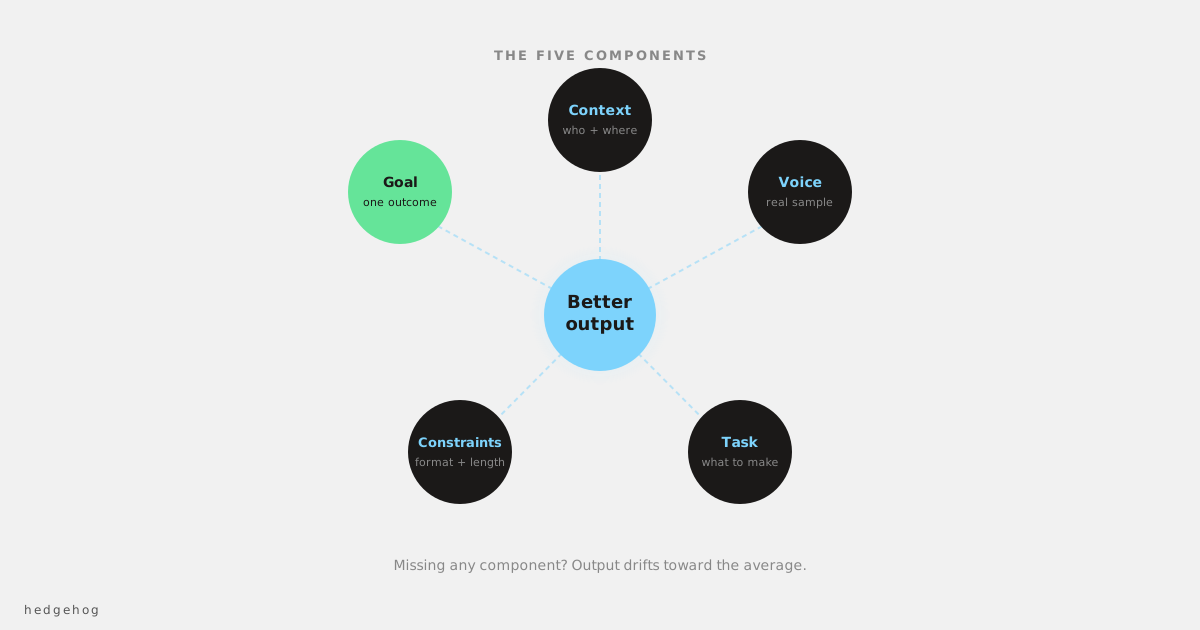
A reliable marketing prompt has five components:
1. Context: who you are, what the business does, who your customers are 2. Voice sample: a real piece of copy you've written, so the AI can match your style 3. Task: exactly what needs to be produced 4. Constraints: format, length, platform, things to include or avoid 5. Goal: the one thing that should happen after someone reads this
Not every prompt needs all five at equal depth. But if your output is consistently disappointing, work through the list and identify which element is missing.
#Before and after: three common tasks
#Social media caption
Before: Write an Instagram caption about email marketing.
Output: "Email marketing is one of the most powerful tools in your arsenal! Whether you're nurturing leads or retaining customers, a well-crafted email can make all the difference. Drop a comment below if you want our top tips! #emailmarketing #digitalmarketing"
After: I run a digital marketing consultancy called Hedgehog Marketing in Australia. My audience is small business owners who are doing their own marketing. Here's how I write: "Most email programs fail not because email doesn't work, but because they were never set up to do any actual work. No automation. No segmentation. Just a newsletter sent when someone gets around to it." Write one Instagram caption in this voice about why most small businesses are underusing their email list. No hashtags. No emoji. One paragraph, punchy, ends with a specific observation rather than a question.
Output: Something that sounds like a real person with a perspective, because you've given the AI enough to work against.
#Email subject line
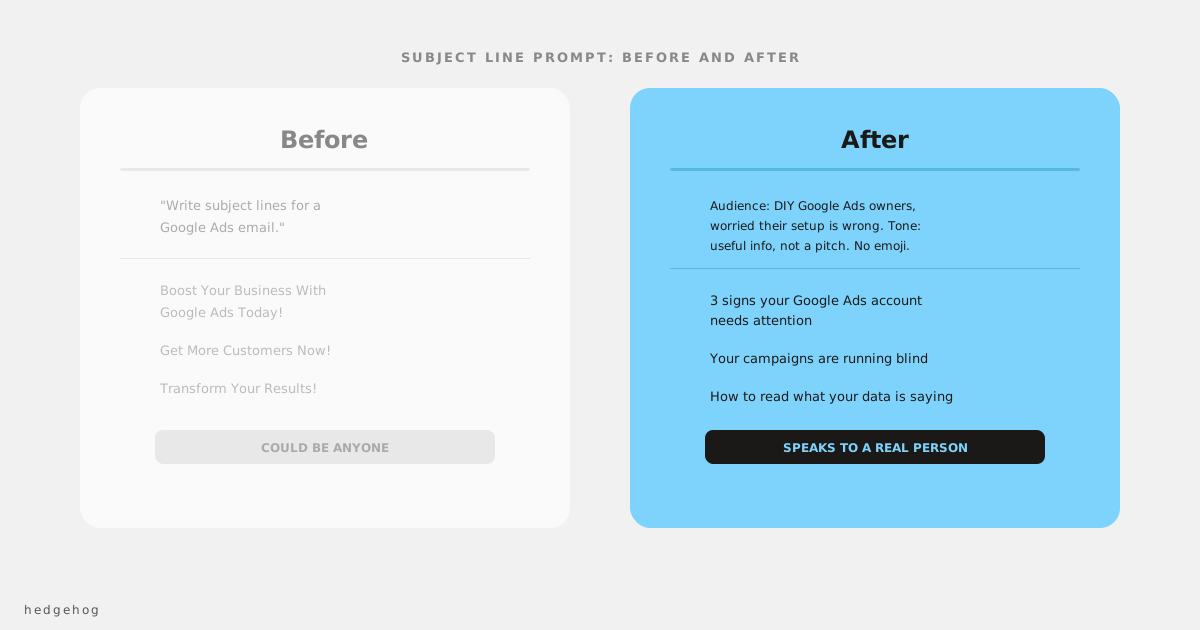
Before: Write subject lines for a promotional email about a Google Ads service.
Output: "Boost Your Business with Expert Google Ads Management!" / "Get More Customers with Google Ads Today!" / "Transform Your Google Ads Performance!"
All of these are promotional, vague, and would get ignored.
After: Write 5 subject lines for an email to small business owners who are currently running Google Ads themselves but aren't sure if their campaigns are set up correctly. The email is going to explain three signs their account needs attention. Tone: honest and direct, not salesy. My audience is skeptical of marketing emails so the subject line needs to feel like useful information, not a pitch. Make them curious without being clickbaity. No emojis.
Output: Subject lines that speak to a specific situation rather than a generic promise, because the prompt described the reader's actual state of mind.
#Blog introduction
Before: Write an introduction for a blog post about Meta Ads for small business.
Output: "In today's competitive digital landscape, Meta Ads have become an essential tool for small businesses looking to reach their target audience and drive growth..."
After: Write the opening two paragraphs for a blog post about why most small businesses are getting poor results from Meta Ads. The real reason isn't their budget. It's that they're sending the wrong message to the wrong audience at the wrong stage of the customer journey. Tone: direct and opinionated, like a knowledgeable friend who's going to tell you the actual problem rather than a vague list of tips. No opener starting with "now" or similar. Start with the diagnosis.
Output: An opening that makes a specific claim and earns the reader's attention, because the prompt named the diagnosis and the tone.
#How to save and reuse prompts that work
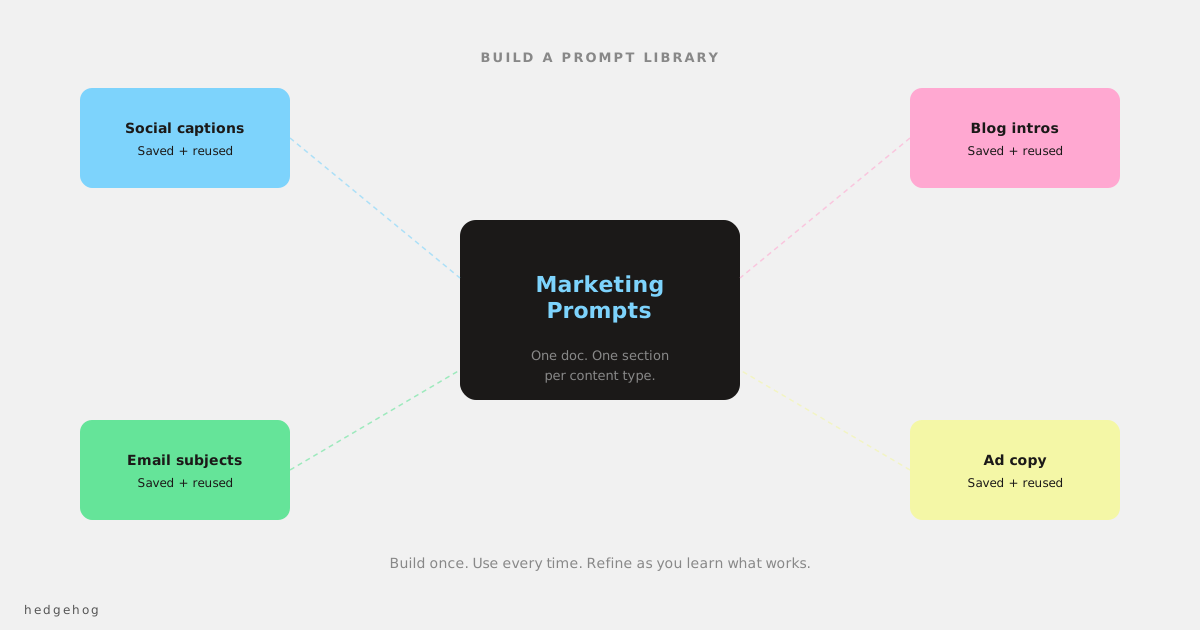
Once you've built a prompt that produces good output for a particular task, save it. Most businesses have a handful of recurring content tasks: social captions, email newsletters, blog posts, ad copy. A saved prompt for each of those tasks, with your voice sample and audience description baked in, means you're not starting from scratch every time.
A simple way to organise this: create a Google Doc or Notion page called "Marketing Prompts." One section per content type. Paste the full prompt, note what it's for, and include a line about what to customise each time (e.g. "swap out the specific topic in line 3").
This compounds quickly. After a month of building and refining prompts, you have a library that produces consistent output in a fraction of the time.
#The one thing that makes every prompt better
Add a voice sample.
This is the single biggest change you can make to any prompt. Before you describe the task, paste in a paragraph or two of copy you've actually written: an email you sent, a social post that performed well, a sentence from your website. Then add: "Write in this voice."
AI is very good at style matching when given a concrete example. It's poor at interpreting adjectives like "warm," "professional," or "conversational", because those words mean different things to different people. An actual sample is unambiguous.
If you don't have a voice sample you're happy with, write one deliberately before you start prompting. Three or four sentences that capture how you want to sound. That investment pays off every time you use AI for copy.
#Frequently Asked Questions
How long should a prompt be? As long as it needs to be to include the five components. For a simple social caption, three or four sentences might be enough. For a blog post or email sequence, a detailed paragraph covering context, voice, topic, and constraints is appropriate. Longer is not automatically better, but leaving out key context always produces worse output.
What if I try a better prompt and the output is still not good? Run it again. AI is non-deterministic: the same prompt produces different output each time. If you get three poor outputs in a row, the prompt is missing something. Usually it's either voice sample or specificity of goal.
Can I use the same prompt structure across different AI tools? Yes. The structure works in ChatGPT, Claude, Gemini, and any other major language model. Different tools have different strengths, Claude handles longer structured prompts particularly well, but the five-component framework transfers.
I don't have time to write detailed prompts. What's the minimum I should include? If you're cutting it short, prioritise voice sample and goal. These are the two biggest components. Context and constraints help, but if you have to pick two, those are the ones.
#The takeaway
Your prompts are your inputs. Better inputs produce better outputs. The five components (context, voice sample, task, constraints, goal) give AI enough to work with to produce something useful rather than something average.
Start with one content type you produce regularly. Build a proper prompt for it. Refine it once or twice. Then save it and use it. That's the whole system.