Every year someone publishes an "email marketing trends" post and fills it with things that were trends three years ago. So let's be direct about what has actually shifted in 2026 and what it means for how you should be running your email program.
The fundamentals haven't changed. Good copy, clean lists, and automations triggered by real behaviour still do most of the work. What has changed is the environment those fundamentals operate in - and a few of those changes are significant enough to affect how you approach the channel.
#What you'll learn in this post
- What's new in email marketing in 2026
- How AI is being used in email (and where it's being overhyped)
- Why deliverability requirements have tightened and what to do about it
- How inbox providers are changing the reading experience
- What to focus on to stay ahead
#Deliverability requirements are now stricter - and non-negotiable
The most practically important shift in the last 18 months happened at the infrastructure level. Google and Yahoo both tightened their requirements for bulk senders in 2024, and those requirements are now firmly the floor for anyone sending at any real scale.
The specific requirements: SPF, DKIM, and DMARC authentication must be configured on your sending domain. Your spam complaint rate (as measured by Google Postmaster Tools) must stay below 0.1%. And you need to offer easy, one-click unsubscribing.
None of this is new in concept - these have been best practices for years. What's new is that they're now hard requirements. Send without them to Gmail addresses and your emails will be filtered or rejected. If your program hasn't been audited against these requirements recently, that's the first thing to fix.
#AI in email marketing: what's real vs the hype
AI tools have improved parts of the email workflow. Subject line testing, content generation for variations, and send-time optimisation are all areas where AI assistance is saving time for marketers who know what they're doing.
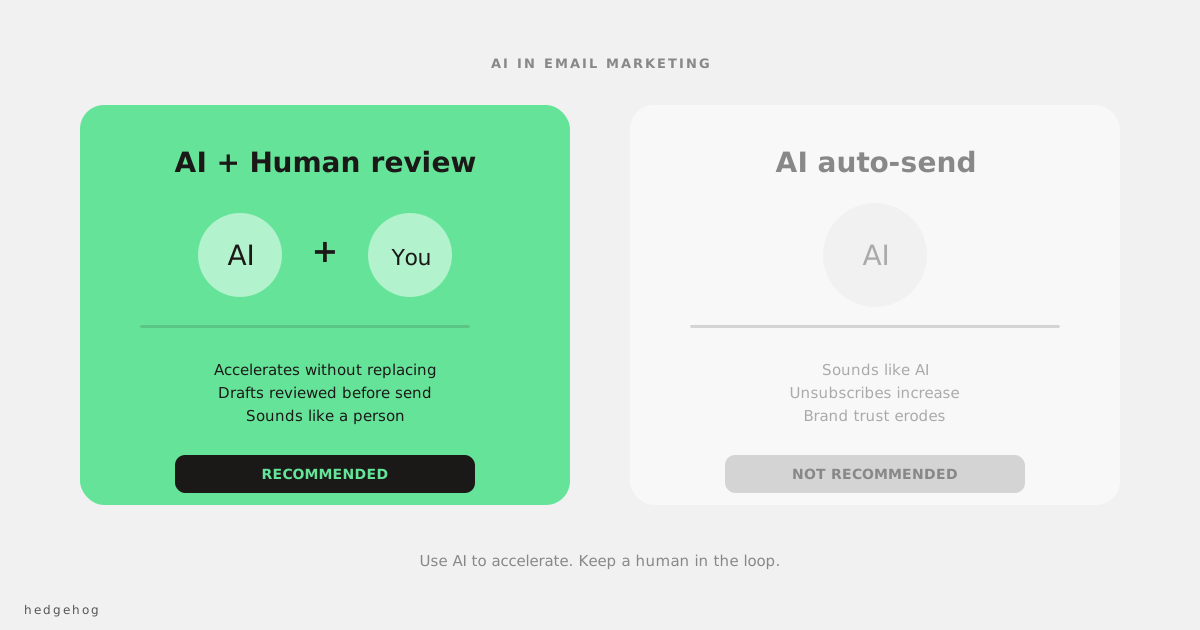
What hasn't changed is this: AI-generated copy that isn't edited by a human who understands the brand sounds like AI-generated copy. Subscribers are better at detecting it than you might think, and "this email sounds like a robot wrote it" is now a real unsubscribe trigger.
The practical position on AI in email: use it to accelerate, not to replace. Use it to generate subject line options, to draft a first pass on email copy, to suggest segmentation logic. Don't use it to auto-send campaigns without review. The returns in email come from emails that feel human and relevant - and that still requires human judgment in the loop.
The platforms are integrating AI more deeply. Klaviyo has AI-driven send time optimisation and product recommendation blocks that pull in real purchase data. Mailchimp has AI subject line suggestions. These are genuine productivity improvements. Use them - just don't hand over the wheel entirely.
#Segmentation has become the baseline, not the advantage
A few years ago, behavioural segmentation was a competitive differentiator. In 2026, it's the minimum. If you're still sending the same email to your entire list, you're behind - that's no longer a differentiator, it's the floor.
The shift that's happening now is the move from segment-based sending to truly individual personalisation. Rather than "here's an email for customers who bought in the last 90 days," it's "here's an email that references this specific customer's purchase history and recommends the logical next product."
For e-commerce businesses on Klaviyo, this level of personalisation is already achievable using dynamic product blocks and flow triggers based on purchase data. For businesses on simpler platforms, even basic segmentation - engaged vs unengaged, buyers vs subscribers - delivers significant improvement over blast sending.
#Interactive and AMP email: still a niche, but growing
AMP for Email lets you embed interactive elements directly in an email - carousels, quizzes, forms that submit without leaving the email, and real-time content that updates on open. It's been around for years but adoption is still limited because Apple Mail doesn't support it. For most Australian businesses right now, the ROI on getting your core automation stack right is significantly higher. Keep an eye on it, but don't prioritise it yet.
#Apple Mail privacy and open rate tracking
Apple's Mail Privacy Protection (MPP), introduced in 2021, continues to affect how you interpret open rate data. MPP pre-loads email content (including tracking pixels) when an email is downloaded to the device, regardless of whether the recipient actually opened and read it. This inflates open rates for Apple Mail users.
The practical adjustment most email marketers have made: stop using open rate as a primary performance indicator. Click rate, conversion rate, and revenue attributed to email are more reliable signals. Open rate is still useful for directional trends and list hygiene decisions, but treat it with caution rather than as a precise metric.
If you're still running your entire program on open rate data without accounting for this, you're making decisions on numbers that don't mean what you think they mean.
#What to actually focus on in 2026
If you want to prioritise your effort, here's where the return is:
Get your authentication right. SPF, DKIM, DMARC, one-click unsubscribe. This is infrastructure. Do it first.
Build or audit your core flows. Welcome series, abandoned cart (if e-commerce), post-purchase, win-back. These automations running well will outperform almost anything else you can do with email.
Segment at minimum. Engaged vs unengaged. Buyers vs non-buyers. Recent purchasers vs lapsed. Even these basic cuts improve performance meaningfully.
Write like a human. With AI in more inboxes, emails that feel genuine and personal stand out more, not less. Invest in good copy.
Measure what matters. Click rate. Revenue per email sent. List growth rate. Unsubscribe rate. These tell you more than open rate alone.
#Frequently Asked Questions
Has email marketing become less effective with so many emails being sent?
No - but the bar for quality has risen. Generic, untargeted emails perform worse than they used to. Well-segmented, relevant, well-written emails still perform very well. The channel rewards quality more than volume.
Should I be using AI to write my email campaigns?
AI is a useful tool for drafting and testing. It's not a replacement for human judgment on what to send, to whom, and when. Use it to speed up your workflow, but always review AI-generated copy before it goes to your list.
What should I replace open rate with as a primary metric?
Click-through rate is a better signal of genuine engagement. Revenue attributed to email (tracked via UTMs in GA4 or your e-commerce platform) is the best performance indicator for commercial email programs.
Is email marketing still relevant if I'm also running social media ads?
Yes - and they work better together. Email gives you a direct, algorithm-free line to people who've already opted in to hear from you. Social ads reach new audiences. The combination of both, with email handling retention and social handling acquisition, is the most effective approach for most businesses.
#Email in 2026: still the workhorse
Email marketing remains one of the highest-return digital channels available. What's changed is that the environment is more demanding - deliverability standards are higher, subscriber expectations are higher, and the platforms are more capable than ever of rewarding programs that use them well.
The opportunity hasn't shrunk. The bar is higher. Fewer people are clearing it. If your program is built on solid fundamentals, 2026 is a good time to be in email.
This guide is written by Hedgehog, a DIY digital marketing consultancy specialising in small and medium businesses in Australia. We offer digital marketing consulting, coaching and training.